
How Bench Warrants Work in New Haven County
A bench warrant is court-generated process commonly tied to a missed criminal or motor-vehicle appearance, a probation matter, or failure to follow a court directive. The precise label comes from the docket and issuing court. It is not always a new criminal charge, and it is not interchangeable with every document called a capias.
Connecticut has one Superior Court, arranged through Judicial Districts and Geographical Areas. New Haven County is only a geographic area. It has no present county courthouse or county sheriff warrant unit. The clerk of the court that issued the process is the first source for status and procedure. Police are a secondary route for execution questions.
Missed Court in New Haven County
A missed date is a court event. Start with the Judicial Branch Case Look-up and its pending Criminal/Motor Vehicle search. Search by last name, then narrow by first initial, birth year, case type, and likely court. Record the full docket, court location, next event, and the page's update date.
A docket line may not show whether a warrant was recalled, stayed, served, or changed after the displayed update. Add-on dockets can also be absent. Call the issuing clerk before appearing. Ask which office handles the matter, whether counsel may appear, whether a motion or new date is required, and what current bond or release information is available.
Do not assume a walk-in clears the warrant. Procedure and custody risk depend on the actual order and current court direction.
Bench Warrant Issuance in New Haven County
Under Connecticut General Statutes Chapter 959, the Superior Court, a judge, or a designated judge trial referee may issue criminal process in the circumstances set by law. The judicial authority controls the decision and sets release conditions. A police department does not create a judicial bench warrant.
Once issued, criminal warrant information may enter PRAWN, the Paperless Arrest Warrant Network. PRAWN is available to authorized criminal-justice agencies, not the public. Its inquiry can show responsible-agency and service data that a public docket may omit. The warrant remains court-controlled until service, recall, vacatur, or another lawful disposition changes it.
The official statutory chapter governing release and bench-warrant provisions is shown below through the source link.
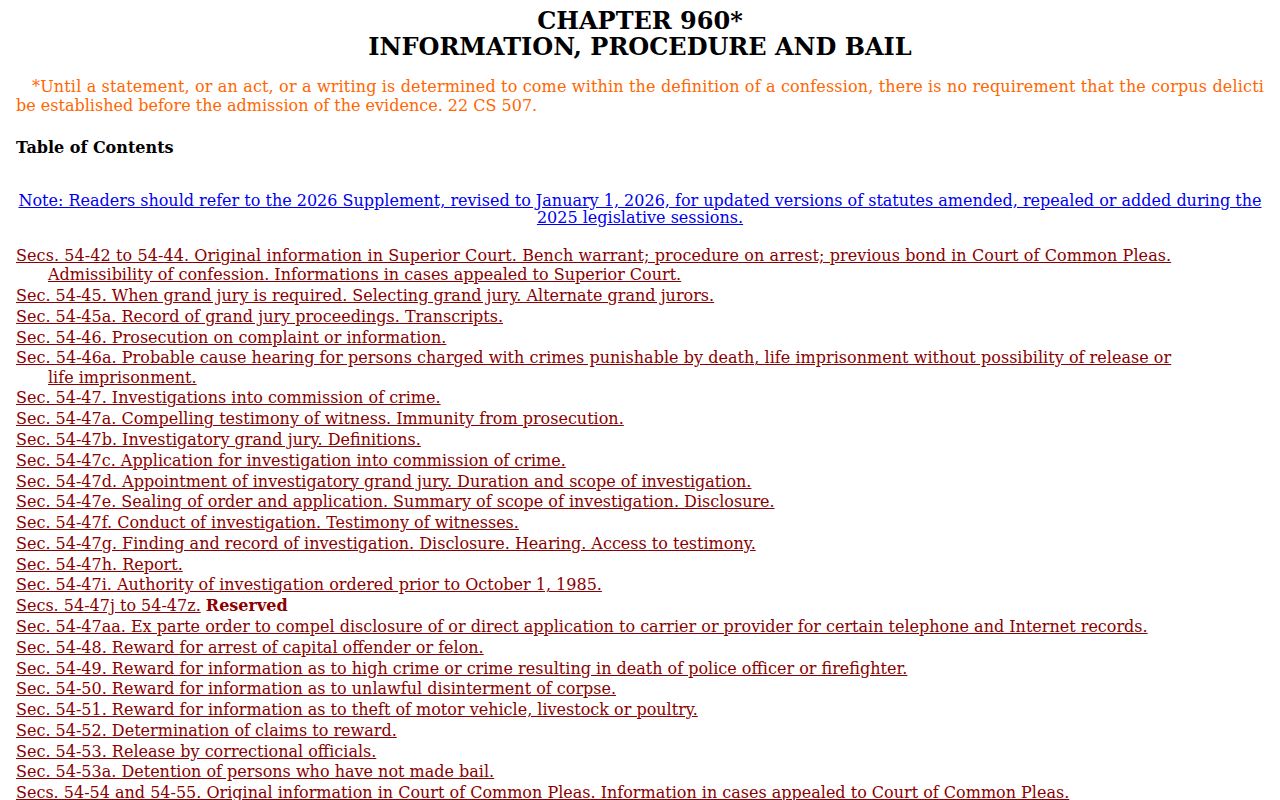
The statute supplies statewide rules, while the issuing court applies them to the individual case.
FTA and VOP in New Haven County
Failure to appear, or FTA, and violation of probation, or VOP, are distinct. FTA concerns a required court appearance. Connecticut Penal Code provisions address first- and second-degree failure to appear, but the docket and court determine the actual process. VOP follows probation, prosecutor, and court channels and may be represented in PRAWN.
The Connecticut Penal Code is the official source for FTA provisions. Its published page appears below.
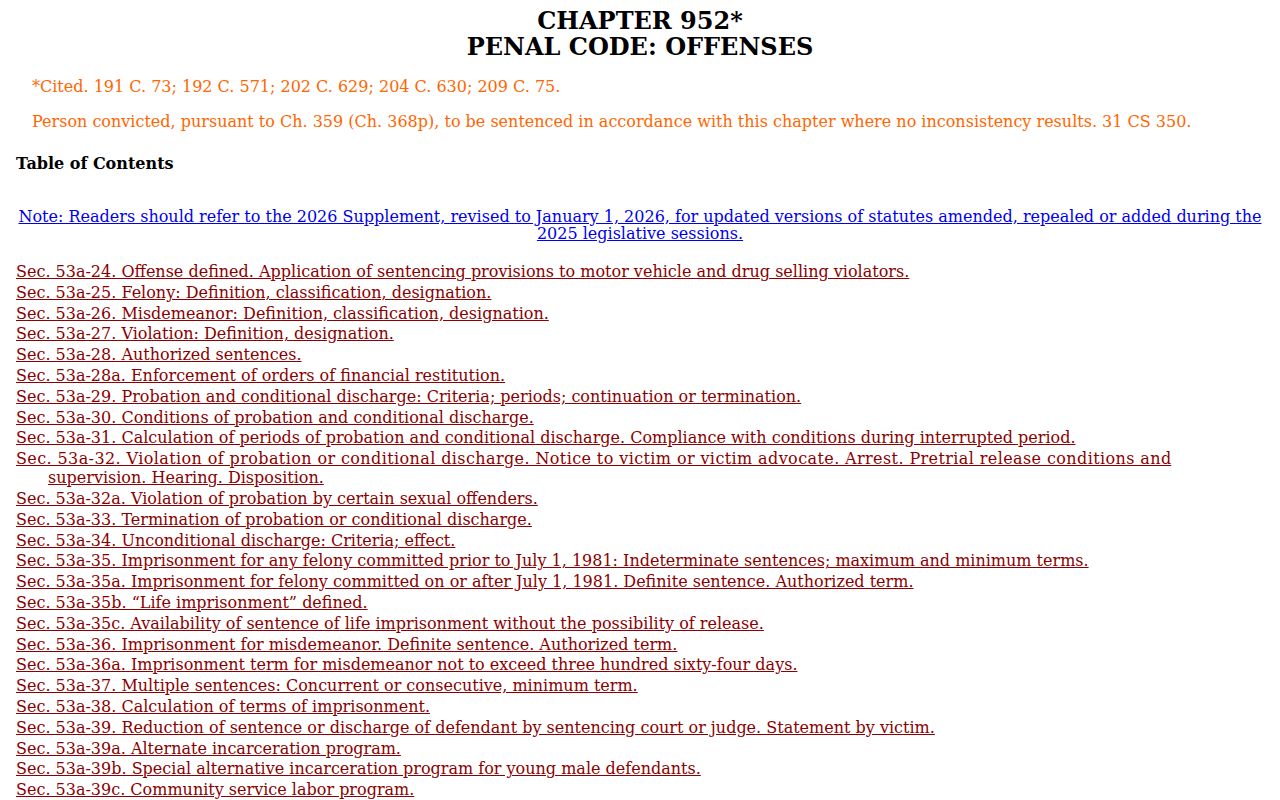
The statute does not replace the current docket or provide personal warrant status. Confirm the precise label and next step with the clerk.
- FTA
- Failure to appear for a legally required court event.
- VOP
- Violation of probation, handled through probation and court channels.
- Recall
- Judicial withdrawal of warrant process under the issuing court's procedure.
- Capias
- A custody command whose meaning depends on criminal, witness, civil, or support context.
How Bench and Arrest Warrants Differ
A bench warrant usually responds to a missed event or unmet obligation in an existing court matter. An arrest warrant is based on probable cause concerning an alleged offense after police investigation, prosecutor review, and judicial approval. Both are issued by judicial authority and may lead to custody, but their records and response paths differ.
A summons directs a person to appear without itself authorizing immediate arrest in the same way. A civil capias may arise from family-support or another civil order and may be served by a State Marshal. Do not use the criminal docket route as proof about civil process.
| Feature | Bench Warrant | Arrest Warrant |
|---|---|---|
| Trigger | Missed appearance or court directive | Probable cause for an alleged offense |
| Who Issues It | Superior Court judicial authority | Judge after a reviewed application |
| Underlying Case | Usually an existing matter | Often a new criminal allegation |
| Response | Court-directed appearance or recall process | Surrender, custody, bond, and court appearance |
New Haven County Traffic Bench Process
If the missed event concerns a traffic ticket, start with the Centralized Infractions Bureau ticket lookup. It searches with the complete ticket number, check digit, and first three letters of the name as printed on the ticket. The CIB path addresses ticket response and reopening, not every criminal bench warrant.
A missed answer can create both court and DMV consequences. Contact the court if the answer date passed. If a suspension notice exists, address the court case and DMV reinstatement separately. Paying a fine or DMV fee does not by itself prove a bench warrant was recalled. Obtain current court status.
No current countywide warrant amnesty or roundup was found. Ordinary CIB payment, plea, and reopening routes should not be described as an amnesty.
Clearing a Bench Warrant in New Haven County
Clearing can mean recall, vacatur, a court appearance, surrender followed by release, or another judicial disposition. No universal New Haven County motion-to-recall form was located. A police Records unit cannot recall a judge's warrant. Begin with the issuing clerk and counsel before taking an action that could result in custody.
- Confirm the docket, process type, and issuing court through the clerk.
- Ask counsel whether a motion, scheduled appearance, or surrender is appropriate.
- Confirm the courtroom, date, identification, filing, and bond instructions.
- Address the missed obligation and obtain proof of the court's new status.
Caution: Do not promise that a voluntary walk-in prevents arrest or produces same-day recall; the court controls the result.
New Haven County Capias Context
Connecticut uses the word capias in more than one context. Criminal statutes permit certain capias process for witnesses, defendants, or court-order violations. State Marshal guidance discusses civil and support capias service, courthouse transfer, and bond information. A civil capias is not automatically a criminal bench warrant.
For family or support process, contact the issuing family court and the assigned State Marshal channel. A State Marshal serves civil process and may explain bond information but does not handle the bond. Judicial Marshals handle courthouse security and custody. For a criminal bench warrant, use the criminal clerk, counsel, and the agency route the court identifies.
Labeling the process correctly prevents a person from asking a city clerk, police Records unit, or criminal docket tool to answer a question held by another custodian.
New Haven County Courts That Issue Bench Warrants
Connecticut has no current municipal criminal courts. Use Superior Court GA and Judicial District routes. New Haven city commonly maps to GA 23 or New Haven Judicial District. Meriden and several central county towns use GA 7. Waterbury uses GA 4 or Waterbury Judicial District. West Haven routes through GA 22 at Milford.
New Haven Judicial District public information is 203-503-6800; New Haven GA 23 is 203-789-7461; Meriden GA 7 is 203-238-6666; Waterbury criminal public information is 203-236-8100; and Milford GA 22 is 203-874-1116. Confirm current contacts in the Judicial Directory. Court Service Centers offer procedural assistance, not legal advice.
Federal Bench Warrants Near New Haven
Federal process is separate from Connecticut Superior Court and PRAWN. Public federal docket information may be found through PACER or a courthouse terminal, but sealed complaints, indictments, warrants, and affidavits may not appear until unsealed. The District of Connecticut clerk is the correct federal court contact.
The District of Connecticut website shown below provides federal court and clerk routing.
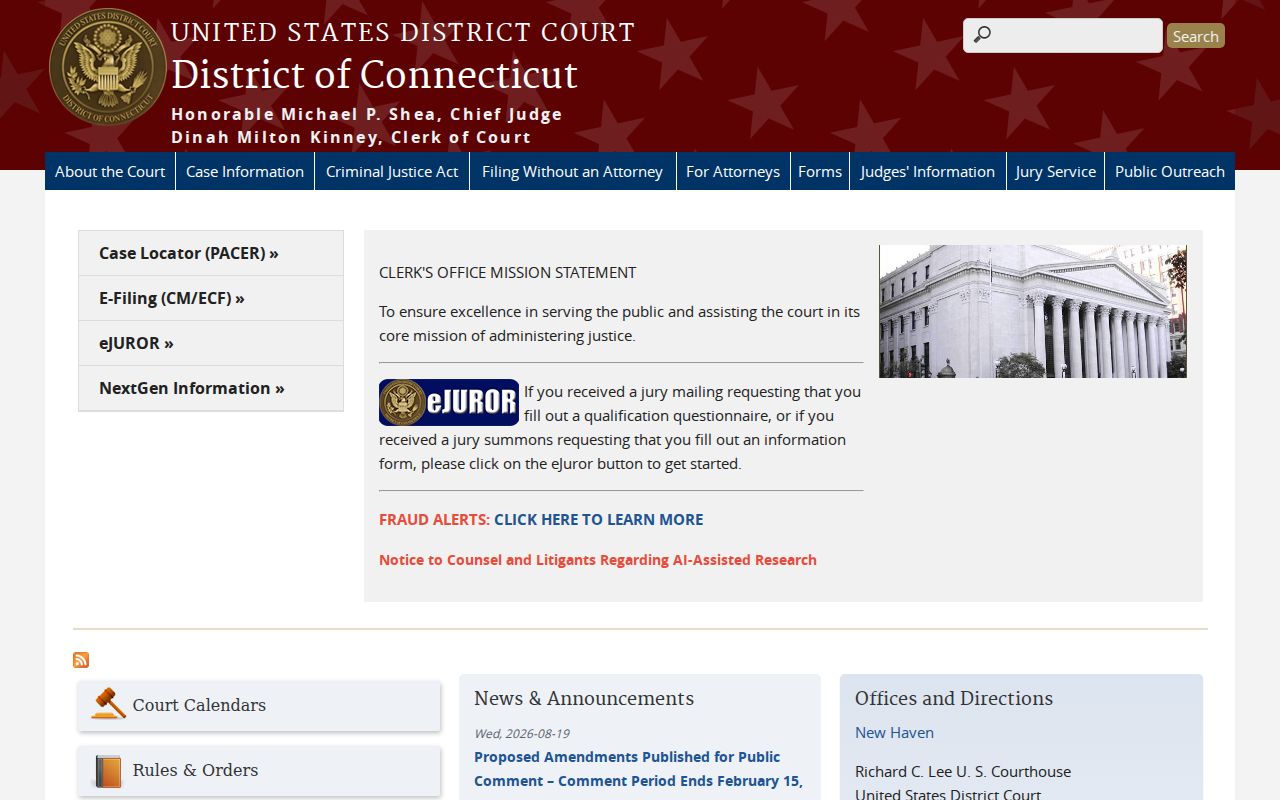
The federal source should be used only for a federal case. A state clerk cannot clear federal process, and the U.S. Marshals Service is an enforcement agency rather than a universal public warrant lookup.
For any forum, a records request is distinct from live confirmation. Connecticut FOI may reach specific releasable state or municipal records but does not override a seal or cancel a warrant. Ask the record custodian for the warrant application, affidavit, return, docket, or release order by exact name and date range.