
New Haven County Warrant Checks
Your first stop is the Connecticut Judicial Branch Case Look-up. Choose the pending Criminal/Motor Vehicle tool, then search by defendant name, court location, or docket number. Give the full legal name and date of birth whenever an office asks for them. A name-only match can land on the wrong person entirely. Treat the result as a lead. It cannot tell you whether a warrant is active, served, vacated, or recalled. Connecticut also keeps its Paperless Arrest Warrant Network closed to the public, and New Haven County posts no sheriff-run warrant list. That is why a careful warrant check always works more than one channel.
- Search pending criminal and motor-vehicle dockets by defendant.
- Note the docket number, court location, case type, and next event.
- Call that court clerk and ask where warrant status is confirmed.
- Contact the originating police records unit for releasable agency records.
- Speak with a Connecticut lawyer before surrender, bond, or a court filing.
No New Haven County Sheriff Search
Connecticut abolished county sheriffs in 2000. Judicial Marshals now run courthouse security and custody, with some courthouse transports. State Marshals serve civil papers. Neither office holds New Haven County criminal warrants. Those questions go to the Superior Court location named on the docket, plus the police agency that sought or executed the warrant. New Haven-area cases may land in New Haven GA 23 or the New Haven Judicial District. Meriden uses GA 7, Waterbury uses GA 4, and West Haven routes through Milford GA 22. The Judicial District and GA table confirms each town's current assignment. The split matters. One call to a New Haven County courthouse never searches every court location or agency record, so check the right one.
Warrants in New Haven County: The Main Types
In New Haven County, one word covers several kinds of court process. A police investigation can produce an arrest warrant. A missed court date can produce a bench warrant. Civil support cases can involve a capias. A search warrant authorizes a search, not an arrest by definition, and each type sits with a different record holder.
| Type | Typical Trigger | Issuing Authority |
|---|---|---|
| Arrest warrant | Probable-cause application in a criminal matter | Superior Court judicial authority |
| Bench warrant | Missed appearance or disobeyed court order | Judge in the pending case |
| Search warrant | Probable cause to search a place, item, or data | Judicial authority |
| Capias | Specified witness, defendant, or civil-support process | Court under the governing law |
Probation-violation and federal warrants follow their own paths in New Haven County. Read the docket and ask which office controls the specific process rather than trusting the label.
PRAWN Is Not a Public Warrant Search
The Paperless Arrest Warrant Network is real and statewide, but it serves authorized justice agencies. Police and court staff use it to manage eligible warrants. No member of the public can run a PRAWN name search. The Judicial Branch lookup landing page shows the actual public starting point for New Haven County.
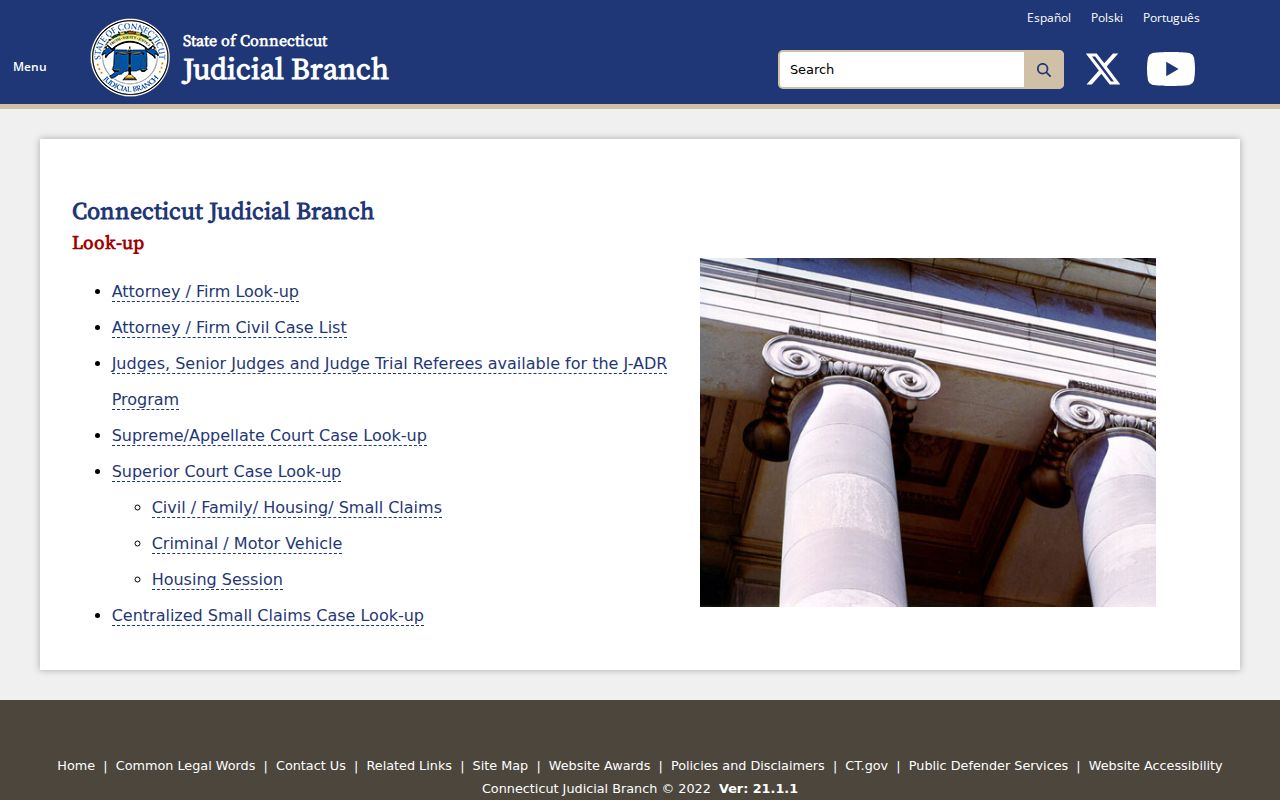
Those separate case categories matter, because the public interface is not the restricted police network. The pending defendant form shows the public name-search route a New Haven County user actually gets.
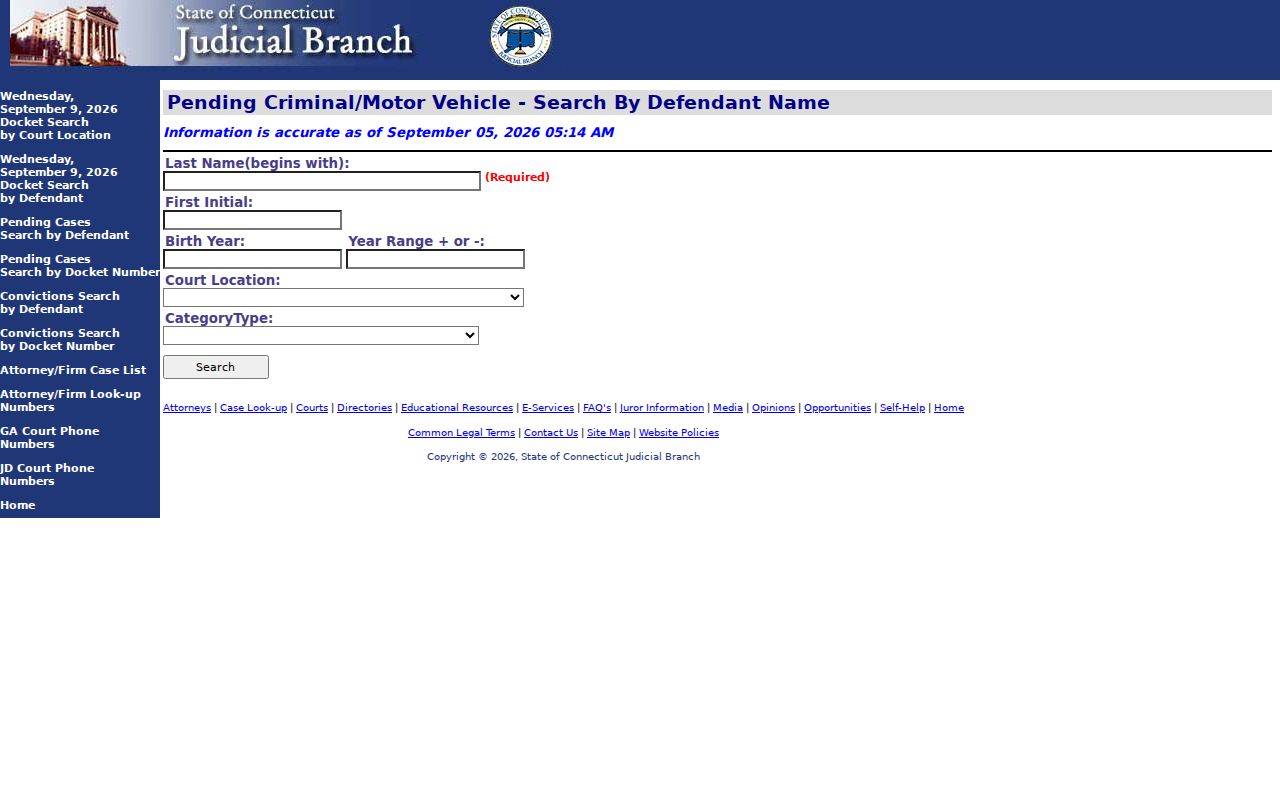
The blank form shows how few identifiers the public supplies. No personal case data is exposed there. A filing may be sealed, too new to appear, erased under Connecticut law, or outside the chosen search. Even a visible docket may not show live operational status. The right clerk or police agency must confirm it. PRAWN began in 2002 and later reached police agencies statewide. That change improved agency exchange, never public name searching, so New Haven County access still runs through dockets, clerks, police records, and lawful requests.
New Haven County Warrant Records: What They Show
Public docket fields help a caller reach the right New Haven County office. Read the court location first, then the docket number and case status. Connecticut docket numbers can encode court location, case type, year, a unique number, and a suffix. Never invent missing digits or treat a sample format as a live warrant number.
| Docket number | The court case identifier, often including a location and case code. |
|---|---|
| Defendant name | The name on the public case, which still needs identity confirmation. |
| Charge or offense | An allegation or motor-vehicle matter, not proof of guilt. |
| Court location | The Superior Court clerk most likely to give procedural routing. |
| Release terms | Case-specific conditions that may change after a hearing. |
| Status or event | A public entry that must be checked against the official record. |
Dates, charge text, and bonds can all change. Identify the New Haven County case, then verify current facts with its source.
Blank New Haven Warrant Results
A blank search is not a clearance certificate. The Judicial Branch itself calls the lookup a public service, not the official court record. Data can lag. Material may be sealed, erased, protected, or held outside the selected category, and a spelling variation can hide a match. The defendant-search screen shows the public name route.
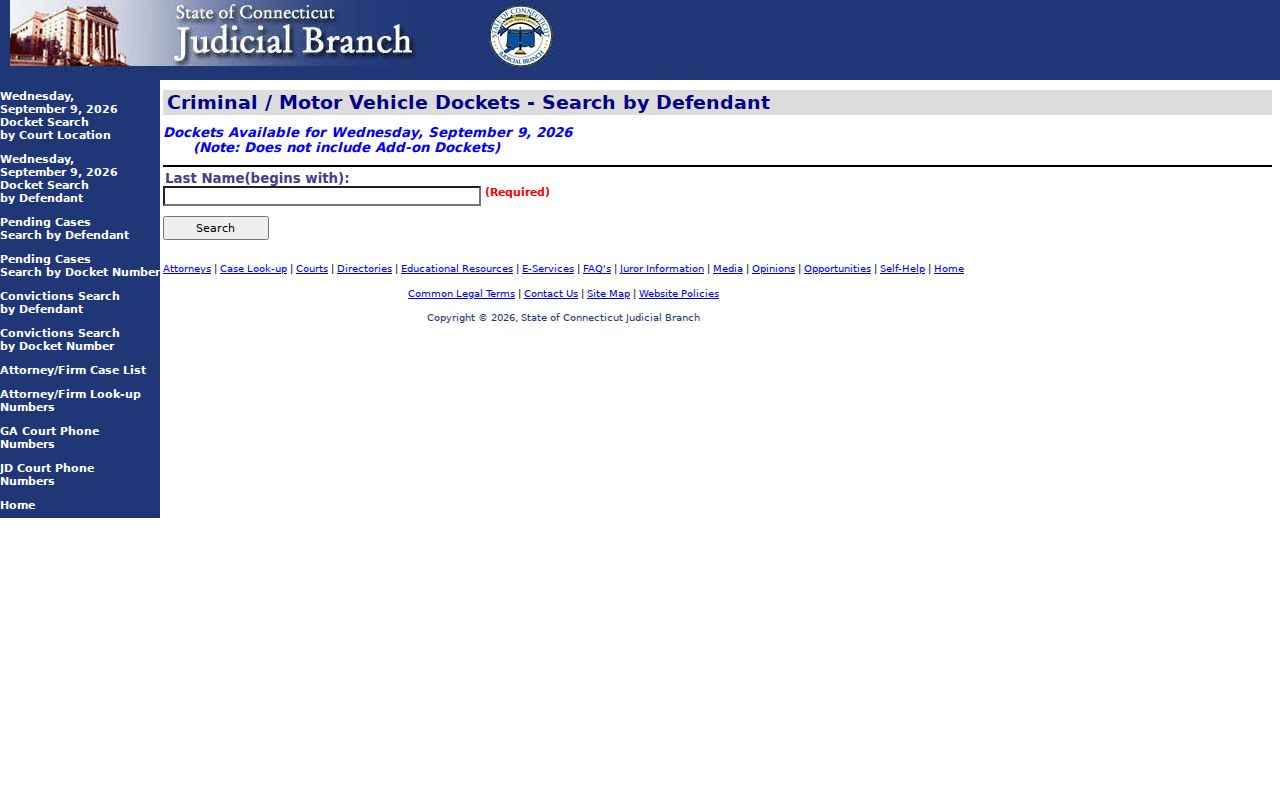
That interface searches public dockets only, so it is not a live active-warrant database for New Haven County. The official court-location search offers another way to narrow the docket set.
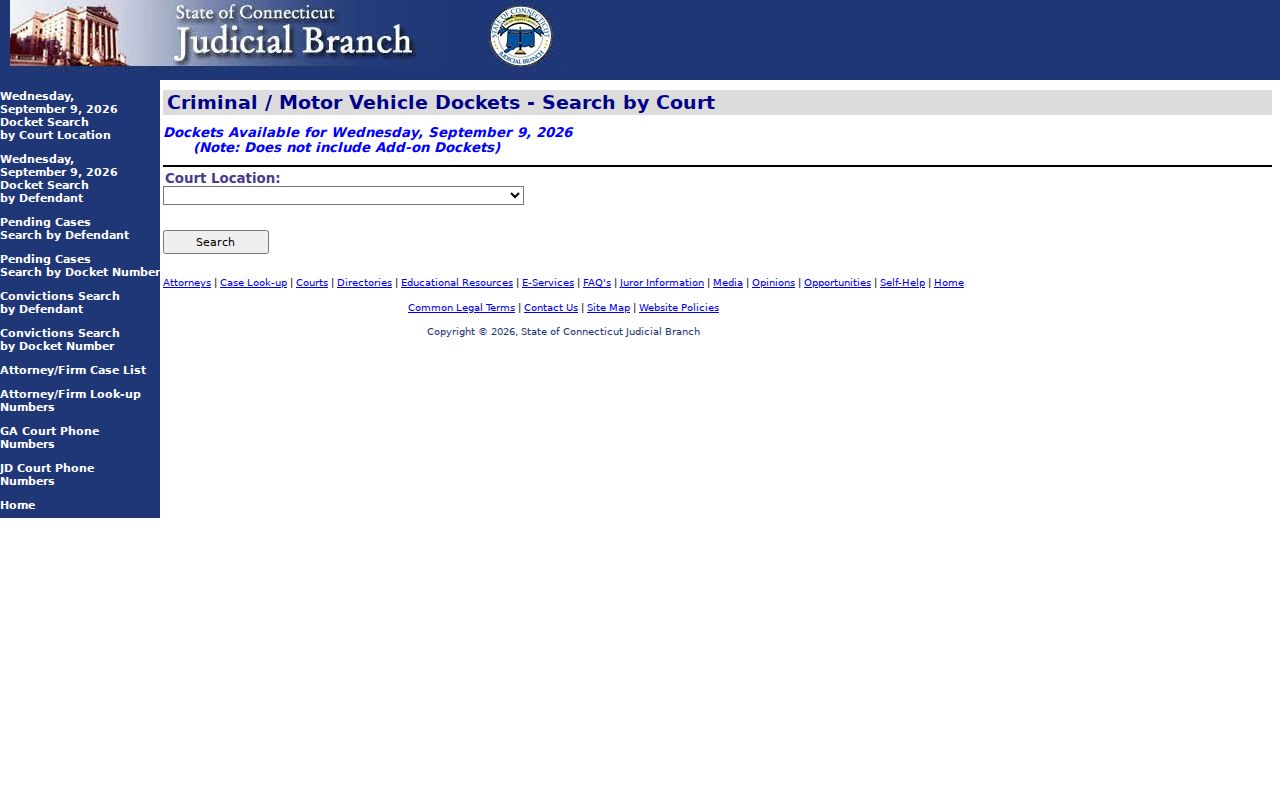
The location list shows why New Haven, Meriden, Waterbury, and Milford routes must stay distinct. Try defendant, court-location, and docket-number searches when you have those details. Then use the Judicial Branch directory to call the proper clerk. Ask whether that office can confirm a pending case or must route the question elsewhere. Police non-emergency and records lines handle agency reports, but a records clerk cannot recall judicial process anywhere in New Haven County.
Key point: No online match does not establish that no New Haven County warrant exists.
New Haven County Warrants: Who Issues, Who Serves
Start with the court, not the street. Connecticut's Superior Court holds original jurisdiction. Police investigate first. The prosecutor forwards an arrest-warrant application, and a judge or designated judge trial referee then decides probable cause and any release conditions. Officers serve what gets signed. New Haven County clerks hold the file and explain procedure, though they cannot rule or hand out legal advice. The New Haven State's Attorney reviews applications across a thirteen-town judicial district, and Waterbury and West Haven cases do not all cross one desk, so use the case location.
New Haven Superior Court, GA 23
121 Elm Street
New Haven, CT 06510
203-789-7461
Want the agency's report? Contact the New Haven County police department that handled the matter, and for a civil capias ask whether State Marshal process is involved.
New Haven Warrant Review by the Numbers
The New Haven Judicial District's official 2024 report gives New Haven County context, not a warrant roster. It logged 5,293 arrest-warrant applications reviewed in 2024. That year's published warrant-type total is 6,732. Across 2021 through 2024, the report tallies 21,152 arrest-warrant reviews against a warrant-type total of 25,790.
These are prosecutor review counts, nothing more. They are not counts of active, issued, served, or cleared warrants. A second agency table, scoped differently, gives 6,847 for 2024. Do not blend the two. The New Haven State's Attorney page links current resources, and its published data names no warrant subject, so treat it as context rather than a list of people.
Handling a New Haven County Warrant
Slow down before walking into any station. If an official source points to a warrant in your name, a Connecticut lawyer can confirm the case and speak with the clerk or the prosecutor. Options include surrender, bond, or a motion. The right path turns on the warrant and its issuing court. A New Haven County clerk can explain filing steps. They cannot choose a strategy. Voluntary surrender suits some cases, and a court can address a bench warrant through an appearance, a motion, or another case-specific act. Release terms belong to the judge and can change, so paying a fee, ordering a report, or fixing a DMV problem still proves no recall. Get the current court status yourself.
Important: Confirm the issuing court and get legal advice before surrender, payment, bond, or any attempt to resolve a warrant.
Traffic Warrants Across New Haven County
Not every unpaid ticket becomes a warrant. Connecticut's Centralized Infractions Bureau covers the check. It lets you look up a ticket with its full number, the check digit, and the first three letters of the surname or company. Electronic tickets can take three to five business days. Handwritten ones may take five to seven. If the answer date has passed, contact CIB through its official email or Live Chat and follow the court's instructions. A missed deadline can trigger added court action and a DMV suspension request. Keep the court and DMV tracks separate. Reopening will not erase an existing DMV reinstatement charge. The CIB ticket lookup shows its required fields, and the New Haven County traffic warrant process page walks the court route in New Haven County without selling you a driving-history product.
Warrant Record Access Under Connecticut Law
Connecticut's Freedom of Information Act sets a baseline right to inspect New Haven County agency records, with exemptions. Court records follow Judicial Branch access rules. Active investigative material, sealed affidavits, juvenile matters, erased records, and private data can all be withheld. Send it to the office holding the record.
Key Rules:
C.G.S. §1-210 states the public-record baseline and exemptions.
C.G.S. §1-212 governs copies, scanning, fees, and prepayment.
C.G.S. Chapter 960 covers release and specified bench-warrant or capias procedures.
A police FOI request can seek a releasable report. It cannot make a New Haven County clerk cancel a warrant or force out sealed material.
Requesting New Haven Warrant Records
A records request seeks a record that exists. It cannot force an agency to answer a legal question, build a new list, or cancel a warrant. Describe the incident, date range, report or docket number, and record type with care. Court filings go to the clerk. Police reports go to the agency. New Haven Police accepts the requests. It warns that released reports can be redacted, and Connecticut FOI guidance says no universal form exists, with each request going to the agency that maintains the material. Fees can apply. If denied, ask for the legal basis. Keep your dates and correspondence for a possible Freedom of Information Commission complaint. Read the state's public-record request guidance before sending a broad demand no New Haven County office can identify, since a precise request is far easier to route and review.
New Haven County Warrant Terms
New Haven County warrant terms read more easily once court roles and codes stay separate. They describe process, not current status.
- PRAWN
- Connecticut’s restricted Paperless Arrest Warrant Network for justice agencies.
- GA
- A Geographical Area court location in the statewide Superior Court.
- Bench warrant
- Process issued after a missed appearance or other court failure.
- Capias
- A court writ used in specified witness, defendant, or civil-support matters.
- Docket
- The official case record and event history kept by the court.
- Recall
- A court act withdrawing a warrant; a web result cannot establish it.
When a term lacks context, ask the New Haven County clerk which case and court it belongs to. A capias is not always a criminal arrest warrant. A docket event is not a live status report.
Federal Warrants in New Haven County
Federal matters run on a separate system. PACER and courthouse terminals open public federal dockets. The District of Connecticut clerk fields those case questions. Sealed complaints, indictments, affidavits, and warrants may stay invisible until unsealed, if they ever are. The U.S. Marshals Service executes federal process and apprehends fugitives, but its public pages are no universal warrant checker. State clerks cannot confirm a federal warrant. Keep federal and state identifiers apart. A Connecticut GA docket never becomes a federal case number, and a blank public docket does not prove that no sealed process exists in New Haven County. Start with PACER or the District of Connecticut, then seek counsel for a live concern.
City Warrant Records in New Haven County
Five big cities, five different channels. In New Haven County, each large city leans on its own police records desk plus a Superior Court docket elsewhere. No city here runs its own criminal court; 2020 Census counts set the ranking.
New Haven Warrants
134,023 · New Haven Police and GA 23
Waterbury Warrants
114,403 · Waterbury Police and GA 4
Hamden Warrants
61,169 · Hamden Police and case-specific court routing
Meriden Warrants
60,850 · Meriden Police and GA 7
West Haven Warrants
55,584 · West Haven Police and Milford GA 22
Every New Haven County city page begins with local police records, then traces the right Superior Court route. That keeps a search at one city office from standing in for a countywide warrant check.