
How Traffic Warrants Work in New Haven County
A ticket does not prove that a warrant exists. Connecticut's Centralized Infractions Bureau, or CIB, first gives the cited person an answer date and a choice to pay or plead not guilty. The state's infractions law also provides a process for failure to pay or plead. Once the answer date has passed, the matter may move from the ticket channel to court, and nonappearance can create a separate court problem. The exact docket, order, and current status must be checked rather than inferred from the old citation.
New Haven County is only a geographic label. It has no county traffic court. A New Haven matter may route to GA 23, a Meriden-area case to GA 7, a Waterbury matter to GA 4, and a West Haven matter to Milford GA 22. The issuing Superior Court location controls the case. CIB can explain the ticket path, but only the court can confirm and change a court warrant.
New Haven County Ticket Answer Dates
The answer date is the key dividing line in a Connecticut infraction. Before that date, the official CIB ticket tool is the first place to enter the ticket data and follow the payment or not-guilty route. Electronic tickets may reach the system sooner than handwritten ones. A ticket that is not yet visible should be checked again or taken to CIB support rather than treated as canceled.
After the answer date, CIB directs users to its support channels, including Live Chat and email, and the court may now hold the matter. Keep the ticket and note the date of each check. The sequence is simple: ticket issued → answer date → pay or plead → court action if the response is missed. That sequence prevents a reader from mistaking an unresolved ticket for a confirmed warrant.
New Haven County Traffic Warrant Checks
Use each channel for the fact it actually holds. CIB checks the ticket. The Judicial Branch public docket offers case clues. The assigned Superior Court clerk confirms court procedure, and DMV handles a separate suspension or reinstatement record. Connecticut's PRAWN system contains operational warrant data for criminal-justice agencies, but the public has no PRAWN login.
- Enter the ticket number, check digit, and the first three letters of the last name in the CIB ticket tool.
- Search the pending criminal and motor-vehicle docket by last name, optional first initial and birth year, then select the likely court.
- Call the assigned clerk. New Haven GA 23 is 203-789-7461, Meriden GA 7 is 203-238-6666, Waterbury criminal clerk is 203-236-8100, and Milford GA 22 is 203-874-1116.
- Ask the clerk whether an in-person appearance, filing, payment, or counsel is required. Confirm the court address before traveling or mailing records.
New Haven County CIB Search Fields
CIB is built around a citation, not a broad name-based warrant sweep. The ticket number accepts eight digits. The check digit is one character, and the last-name field uses the first three letters. Those limits matter because a transposed number or missing check digit can yield no useful match even when the ticket still needs an answer.
| Field | Format | Use |
|---|---|---|
| Ticket number | Eight digits | Identifies the citation |
| Check digit | One character | Validates the ticket number |
| Last name | First three letters | Matches the cited person |
The official capture of the Connecticut traffic ticket portal shows the court-run entry point used statewide.
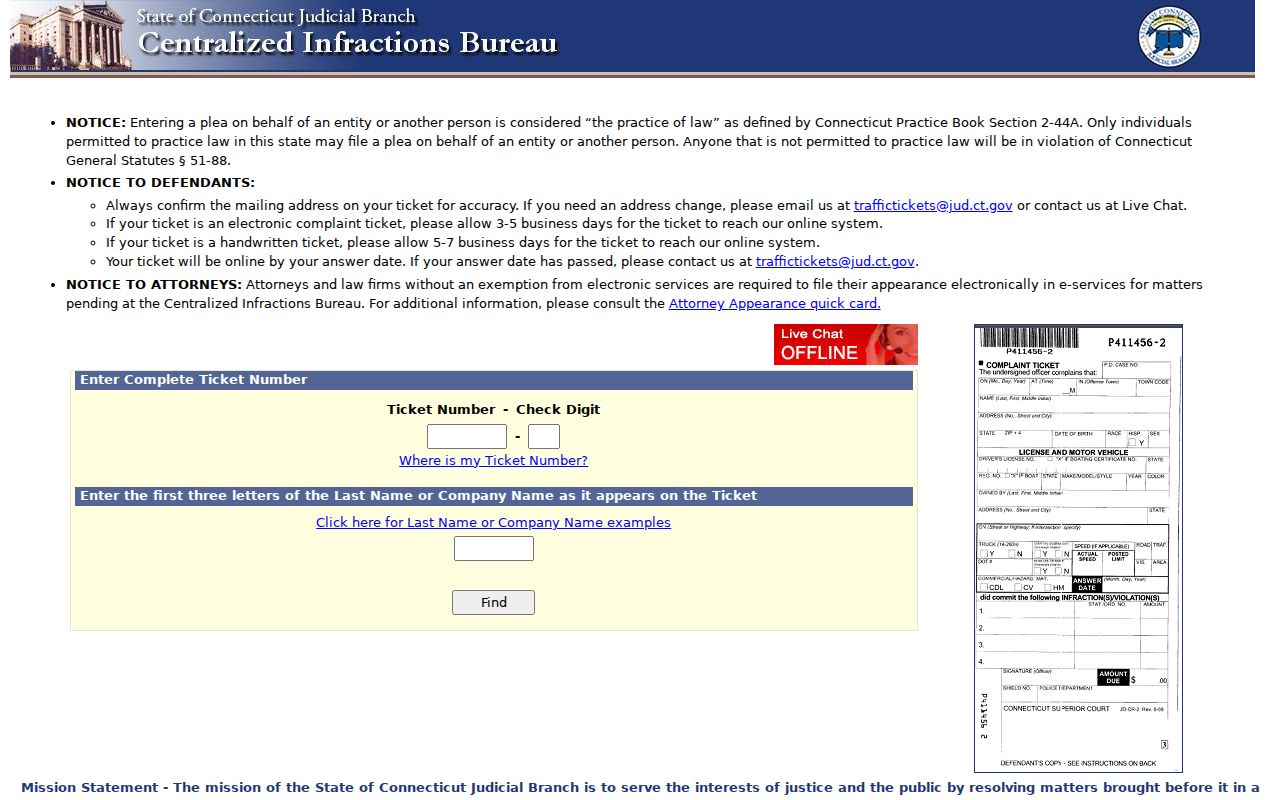
The portal image reinforces why the ticket identifiers should be copied exactly before the answer date is checked.
Traffic Warrants: What They Show
A public court result may show the court code, docket number, charge or motor-vehicle offense, case status, next court date, and a disposition or release indicator. It does not promise a live warrant-status field. Keep the citation number and the court docket distinct. A safe sample such as 12345678-A illustrates the ticket-number and check-digit pattern without copying a person's record.
| Ticket or docket number | Identifies either the citation or later court case; the two numbers may differ. |
|---|---|
| Charge or offense | Names the infraction, violation, or later failure-to-appear matter shown on the docket. |
| Issuing court | Names the Superior Court GA that controls court action. |
| Fine or release terms | Shows an amount only when the public record publishes one; confirm current terms with the clerk. |
| Status | May show pending or disposed case status, which is not always the same as live warrant status. |
New Haven County Traffic Court Routes
Select the court tied to the ticket, not the court nearest the current home. Four routes cover the major cities in this geographic county. New Haven GA 23 is at 121 Elm Street. Meriden GA 7 is at 54 West Main Street. Waterbury criminal matters use 400 Grand Street. West Haven cases route to Milford GA 22 at 14 West River Street.
The Judicial Branch town assignment table is the best source for a municipality not named here. A move after the ticket was issued does not shift the case. If the public docket offers more than one plausible location, call the listed clerks and give the citation or docket number rather than asking for a broad county search.
Note: A city police records office can route a call, but it cannot recall a Superior Court warrant.
Clearing a New Haven County Traffic Warrant
First learn whether the open item is still a CIB ticket, a court docket, a bench warrant, or a DMV action. “Clear” may mean reopening a case, making a required appearance, paying a court amount, or obtaining a judicial recall. Payment by itself is not a universal warrant remedy. A clerk may explain procedure, while an attorney can advise how to address the order and whether an appearance should be arranged.
- Confirm the ticket, docket, issuing GA, and current order with CIB or the court clerk.
- Ask what filing, payment, plea, or appearance the court accepts and which methods are current.
- Use counsel when surrender, release conditions, or a motion to recall may be involved.
- After court action, confirm both the court status and any separate DMV reinstatement requirement.
Warning: A payment receipt does not prove that a warrant was recalled; verify the court order and any separate DMV status.
New Haven County Court and DMV Split
The court and DMV maintain different parts of the problem. The court controls the ticket case and any warrant. DMV controls the license record and reinstatement process. The DMV suspension guidance says that reopening a case before a suspension takes effect can avoid suspension. After suspension, the current DMV material lists a $175 reinstatement fee, apart from court fines and fees.
The official DMV source illustrates the separate state channel used after a New Haven County traffic case affects a license.
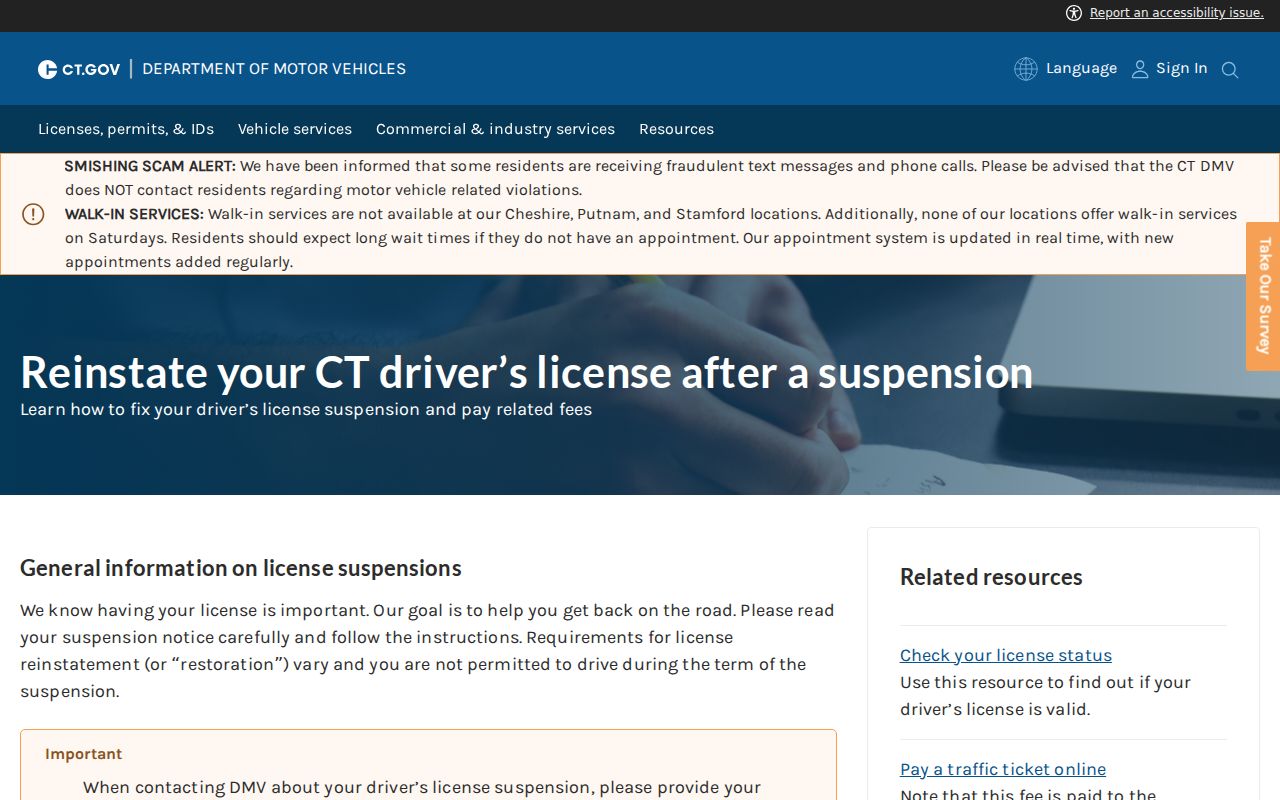
This separation is why a court receipt should be followed by a DMV check when suspension has already begun.
The separate DMV reinstatement page shows the payment channel and its processing warning.
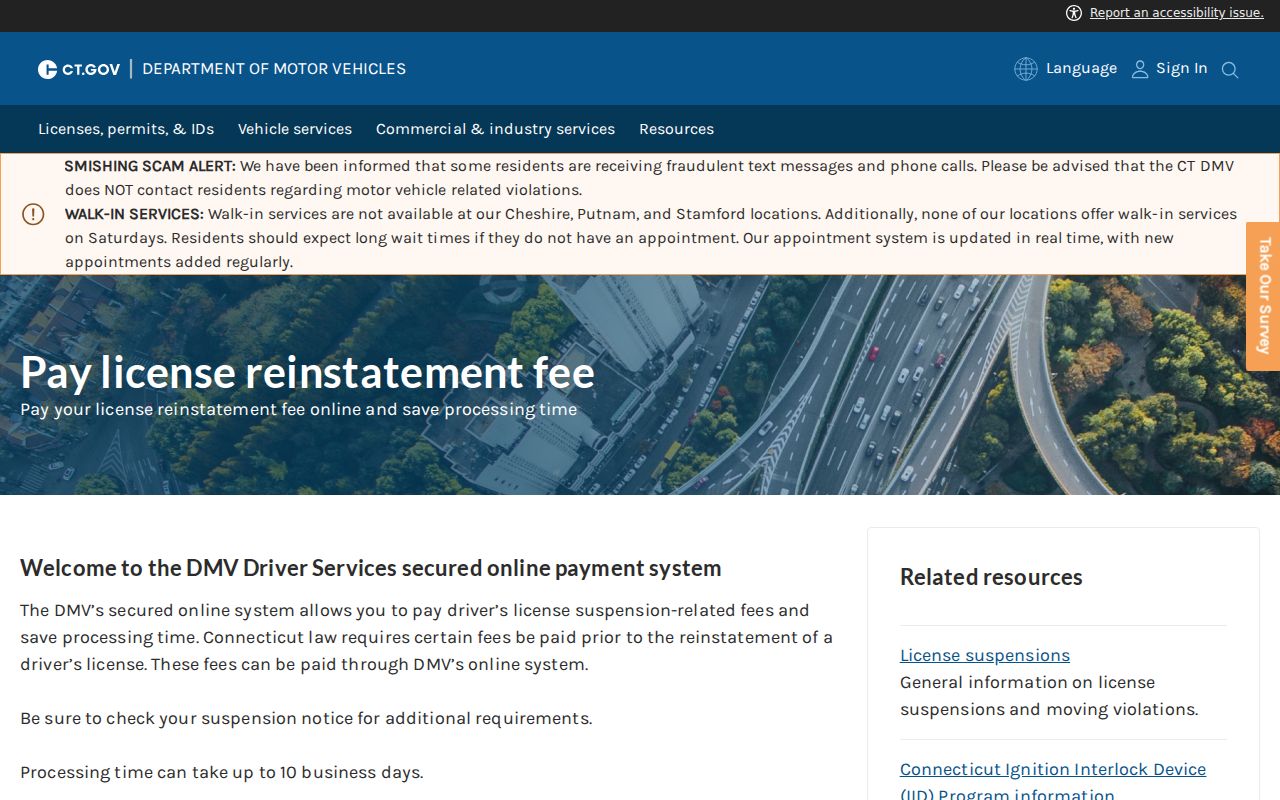
That notice confirms why paying DMV is not the same act as clearing the court case or recalling a New Haven County warrant.
How Traffic Warrants Trigger License Holds
One missed ticket response can produce distinct records. A traffic-related warrant is court process. FTA means failure to appear and may be charged under Connecticut law when a required court appearance is missed. A license suspension is an administrative DMV result. None should be assumed solely because another appears. Confirm each with its own custodian.
| Mechanism | What Triggers It | What It Does |
|---|---|---|
| Traffic-related warrant | A court order after the matter reaches court | Authorizes custody under the court's terms |
| Failure to appear | A required court setting is missed | May create a separate criminal court issue |
| License suspension | DMV receives the qualifying court notice | Stops lawful driving until reinstatement steps are met |
New Haven County Blank Search Results
A blank CIB or court result is not a clearance letter. The ticket may be too new, a handwritten citation may not yet be entered, a name may differ, the wrong GA may be selected, or the case may have moved beyond the pending search. Add-on dockets and restricted records also limit what the public page can show. PRAWN was not searched because it is not a public database.
Key point: Use the online result as a lead, then ask the assigned clerk to confirm the current court process.
For a family member, staff may limit details without authority. The useful request is for the correct office and public procedure, not protected data. If the issue may be federal, use PACER and the District of Connecticut clerk because a state traffic search cannot clear a federal matter.